

Should Universities Outsource Academic Video Production? The Honest Cost & Quality Comparison
By SR Creative Productions · 12 min read · October 2026
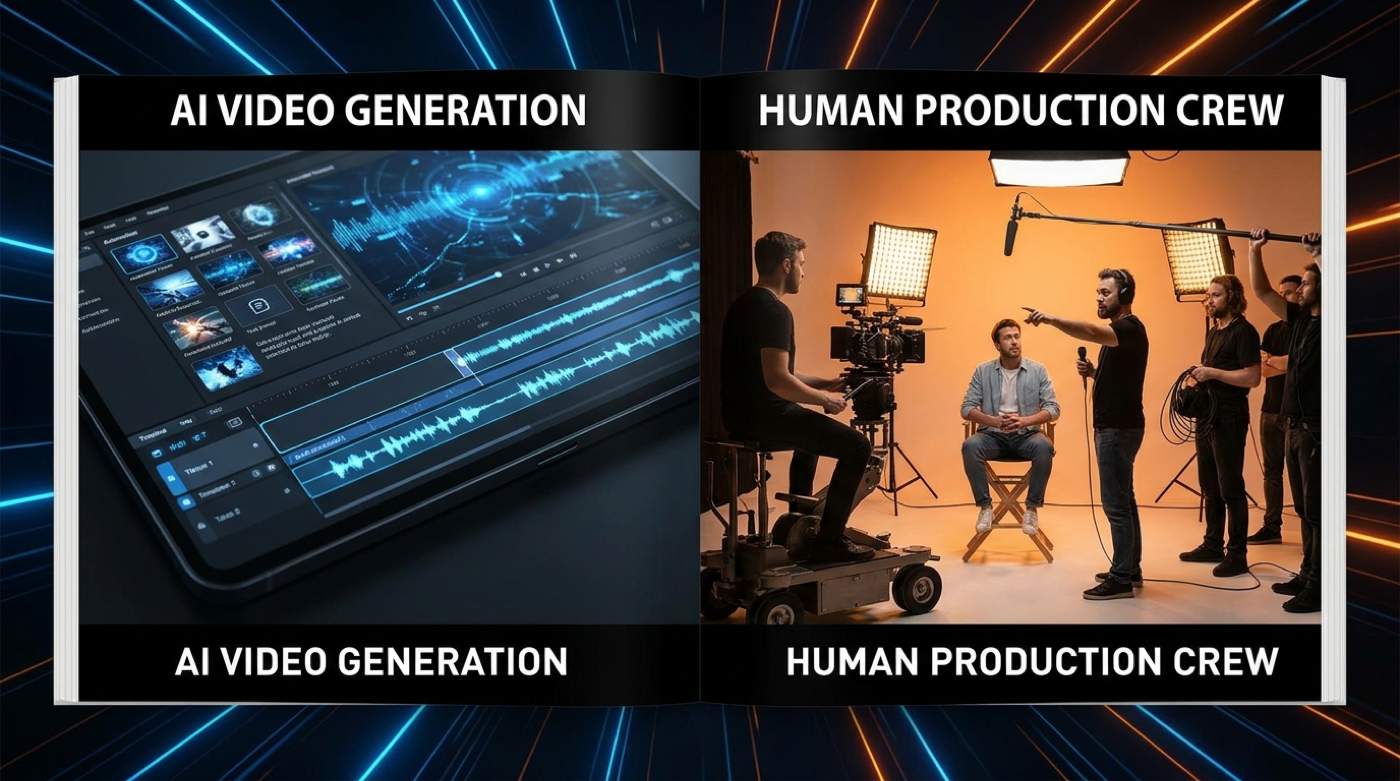
Every university that launches an online degree or MOOC program faces the same early decision: build the production capability in-house, or find an external partner?
This is rarely a purely financial decision — it involves questions of institutional control, quality consistency, speed to launch, and long-term scalability. But the financial dimension is where most institutions make their biggest planning errors: underestimating the true cost of in-house, and overestimating the price of a specialist agency.
This piece gives you the honest numbers — drawn from real production engagements — so you can make a well-informed decision rather than discovering the real cost six months into your first program.
The True Cost of In-House Academic Video Production
When university administrators consider building in-house production capability, they typically think about staff salaries and equipment. The real cost is significantly higher once you account for:
Staffing
A minimum viable in-house team for consistent video production needs at least two people: a camera/production operator, and a post-production editor. In Mumbai or Delhi NCR, mid-level talent runs:
- Video editor (3+ years, Adobe Premiere + After Effects): ₹45,000–₹70,000/month CTC
- Camera/production operator (2+ years): ₹35,000–₹55,000/month CTC
Add EPF, ESIC, gratuity provision, and indirect HR costs: fully-loaded annual cost for both roles: ₹12L–₹18L per year.
Equipment (Capex)
- Camera kit (Sony FX3 or equivalent, 2 bodies): ₹4L–₹6L
- Lighting kit (3-point LED with stands): ₹1L–₹2L
- Audio kit (wireless lapel, shotgun, interface): ₹80K–₹1.5L
- Edit workstation x2 (Mac Studio or PC equivalent): ₹3L–₹5L
- Edit monitors, storage, accessories: ₹1.5L–₹3L
- Set design, greenscreen, misc: ₹50K–₹1L
Total equipment capex: ₹11L–₹19L upfront. Amortised over 4 years: ₹2.75L–₹4.75L per year.
Software
- Adobe Creative Cloud (2 seats): ₹1.2L/year
- Davinci Resolve Studio (optional): ₹30K one-time
- Caption and transcription tools: ₹40K–₹80K/year
- Cloud storage and asset management: ₹60K–₹1.2L/year
Total software and storage: ₹2.5L–₹4L per year.
Staffing ₹12–18L + Equipment amortisation ₹2.75–4.75L + Software ₹2.5–4L = ₹17L – ₹26.75L per year at steady state. Year 1 is higher due to equipment purchase: ₹28L – ₹45L all-in.
What does that buy you? Approximately 100–150 finished lecture hours per year, assuming the team can sustain efficient output across the academic calendar without significant downtime during off-peak periods.
The Cost of Outsourcing to a Specialist Agency
An agency retainer for a comparable output volume looks like this:
- 100 hours of standard lecture edits at ₹10,000/hr: ₹10L/year
- 20 hours of enhanced modules with motion graphics at ₹18,000/hr: ₹3.6L/year
- Annual brand template build and maintenance: ₹1.5L
- Dedicated production manager (included in retainer): ₹0 additional
Total agency cost for equivalent output: ₹15.1L per year. No capex. No HR overhead. No software licences. Scales up or down with your actual content volume each semester.
Side-by-Side Comparison
| Factor | In-House Team | SR Creative Retainer |
|---|---|---|
| Year 1 cost (100 hrs output) | ₹28L – ₹45L | ₹15L – ₹17L |
| Ongoing annual cost | ₹17L – ₹27L | ₹12L – ₹18L |
| Capex required | ₹11L – ₹19L | None |
| Scalability | Fixed — hiring more staff takes months | Flexible — scale within 1 week |
| Motion graphics / animation | Requires specialist hire (₹6–10L additional) | Included in scope |
| Platform delivery expertise | Self-learned — error-prone initially | Presets built for Coursera, edX, NPTEL |
| Staff continuity risk | High — one resignation disrupts production | None — team depth managed by agency |
| Off-peak utilisation | Low — paid staff even during semester breaks | Pay only for work done |
| Institutional control | Full | High — with structured handoffs |
When In-House Does Make Sense
We are a production agency, so you would expect us to recommend outsourcing. But in-house genuinely wins in some scenarios — and it is worth being honest about that:
In-house is better when:
You have an existing communications or AV team with spare capacity. Your content volume is below 40–50 videos per year and is unlikely to grow significantly. You need day-to-day reactive content (event coverage, faculty announcements, social media clips) that benefits from being on-site. Your institution has regulatory or IP-sensitivity requirements that make external data handling complex. You already have the equipment and do not need to invest.
Outsourcing is better when:
You are launching a new online program and need quality at launch, not after 12 months of team-building. Your content volume exceeds 50 videos per year and is growing. You need specialist skills — motion graphics, animation, AI avatar modules — that a generalist in-house editor cannot provide. Your academic calendar creates feast/famine production cycles that are expensive to staff for at peak. You want a fixed, predictable cost per deliverable that can be directly attributed to the program budget.
The Hybrid Model — What Leading Institutions Actually Do
The most effective model we see at established institutions is a hybrid: a small in-house team (one production coordinator, sometimes one editor) handles reactive day-to-day content and acts as the internal interface with faculty. A specialist agency partner handles the volume program production — the online degrees, the MOOCs, the complex module builds.
This gives you institutional knowledge, editorial oversight, and relationship continuity inside the university, while keeping specialist post-production costs variable and accessible to a depth of skills that no small in-house team can match.
A university launches a 30-credit online MBA. The in-house coordinator manages the filming schedule, liaises with faculty, and uploads finished files to the LMS. The agency receives raw footage, handles all post-production, and returns platform-ready files within 48–72 hours. The coordinator reviews and approves. Faculty revisions are submitted back to the agency with a 24-hour turnaround guarantee. The agency is invisible to faculty — it operates as a seamless extension of the university's production capability.
Questions to Ask Before You Decide
Before committing to either path, get clear on these:
- What is your content volume for Year 1, Year 2, Year 3? If you genuinely don't know, start with a small agency engagement — the flexibility is worth more than the marginal cost saving of in-house.
- Do you have budget owner support for capex? Equipment purchase requires capital approval in most university procurement processes — this often takes longer than a program deadline allows.
- What happens if your only editor resigns mid-program? The answer to this question usually decides the outsourcing question on its own.
- Is your content type consistent or diverse? Consistent talking-head lectures are easy to in-house. Diverse content (animation, screen recording, multi-location filming, branded graphics) is better served by an agency with specialist depth.
Let us build a production proposal for your program
We offer a free scoping session for university teams — covering scope, cost, timeline, and a clear answer to whether in-house or a partnership makes more sense for your specific situation. No obligation, no sales pressure.
Book a Free Scoping CallFrequently Asked Questions
Is it cheaper to produce academic videos in-house or outsource?
Below 50 videos per year, costs are comparable. Above that threshold, outsourcing is typically 1.5–2× cheaper when you account for the fully-loaded cost of in-house staffing, equipment amortisation, software, and off-peak idle time. Year 1 in-house costs are significantly higher due to equipment capex.
What are the hidden costs of in-house academic video production?
The most underestimated: equipment depreciation (cameras and edit workstations — ₹15–25L upfront), software licences (₹2–4L/year), staff idle time during semester breaks, and the cost of upskilling editors as platforms and tools evolve. Most institutions also underbudget for cloud storage and asset management infrastructure.
How do universities brief a post-production agency?
An effective brief covers: program overview, delivery platform and specs, brand guidelines, approval workflow, footage delivery method, and target launch date. SR Creative Productions provides a structured intake form that covers all of this in a 15-minute session with your team.
What is a reasonable turnaround time for academic video post-production?
Standard lecture edits: 48–72 hours from footage receipt. Enhanced modules with motion graphics: 4–5 business days. For programs with consistent weekly footage delivery, a predictable production cadence is established at the start of the engagement.
Can an agency maintain brand consistency across a full degree program?
Yes — and often more consistently than an in-house team, because the agency builds master brand templates at the start that are applied automatically to every module regardless of which editor works on it. SR Creative Productions maintains institution-specific After Effects template libraries for all long-term clients.